


In the heat of high summer in Shandong, the drone of cicadas rides the heatwave through the streets. Gaokao scores have begun to come out, and millions of families are instantly thrown into the anxiety of filling in their university applications. For most people, hitting "confirm" on the application form takes no more than a few minutes. But for two families — those of Xiaoxin and Xiaocheng (both pseudonyms), whose parents work in infrastructure — those few clicks came after weeks of tossing and turning adrift in a flood of information, weeks of bewilderment and helplessness.
The father is posted to project sites year-round. The mother stays behind on her own to see the child through school. The child keeps his head down over practice papers. The whole family runs the marathon of the gaokao with everything they have — and then loses its bearings at the crossroads of choosing a university. Their phones are stuffed with scattered short videos, university information forwarded in WeChat groups, densely packed program descriptions on web pages. The more information there is, the less certain they feel.
This is the portrait of countless infrastructure-worker families. They build the city's towers, roads and bridges with their own hands, yet at the most consequential decision point in their child's life, they cannot offer professional guidance on what comes next.
Having been deeply rooted in the infrastructure industry for years, SY Holdings long ago came to understand the everyday reality of frontline builders: living away from home, and far more time apart than together. Over the years, the SY Charity Foundation has run programs such as the "Hearts in Bloom" summer camp for the "little migratory birds" of construction sites, caring for the growth and companionship of infrastructure workers' children.
This year, the foundation extended its charitable reach into gaokao application guidance for the first time with the "Blooming Futures" student-aid program. Together with Fengxue Weilai, the education company founded by Zhang Xuefeng — China's leading popularizer of college-admissions know-how — it brought free one-on-one professional admissions counseling to infrastructure families, delivering real help to the families who need it most.
A story about conviction
Everyone said civil engineering was finished. He filled all 58 choices with civil engineering anyway.
The day her son's score came back — 524 — Xiaoxin's mother clutched her phone and checked it over and over, unable to hide her joy. "This is the best he's done in three years of high school. He's just one point shy of Shandong's special-type admission control line."
"I only want to study civil engineering!" Growing up watching his father move from one construction site to another, Xiaoxin felt a natural affinity for civil engineering, mechanics and drafting, and had made up his mind early. But the flood of online commentary declaring that "the civil engineering industry is dead" left all three of them wavering: the boy had the interest — but could he build a stable future on it?

"Given your family's situation, civil engineering is actually the optimal choice," said counselor Qi of Fengxue Weilai after hearing them out. He explained that the industry is in a downcycle and admission scores have fallen sharply, so the same score can reach a long-established first-tier university known for architecture and civil engineering — whereas a currently popular engineering major might only get them into an ordinary second-tier school. Infrastructure underpins people's livelihoods: the industry has cycles, but it will not disappear. And the father's decades of industry experience is a form of capital no one else's child has.
In the final application list, counselor Qi worked from the provincial rank tables to build 58 university–program options. Xiaoxin, for his part, understood both of his parents: he respected his father's wish that he go to a big city and broaden his horizons, and he understood his mother's reluctance to let him go too far from home, so he took the initiative to reorder his preferences. The overall plan used strong architecture-focused universities in Shandong as the safety net, paired with a handful of prestigious universities in other provinces as reach options. Every program was locked into the civil engineering category.
For Xiaoxin's family, the most precious thing about this guidance was never that it found a "better" path — it was that it confirmed the path they had chosen was viable. When a child's passion, a family's accumulated experience and an industry's opportunities happen to line up, one resolute choice is worth far more than a hundred wavering attempts.
The boy who had once hesitated under the weight of outside opinion could finally see the clear path of growth behind the thing he loved.
A story about crossing boundaries
Xiaocheng, who used to "take each step as it came," says for the first time: "I want to go to grad school."
Unlike Xiaoxin, whose goal was clear, Xiaocheng — 486 points, ranked around 240,000 in the province — was stuck with his family in a bind: no strong engineering programs at public universities within Shandong, and private bachelor's degrees far too expensive.
His father works on construction sites year-round; his mother stays home caring for two children. The family had very few channels for getting admissions information. "There's plenty you can dig up online, but you simply can't tell what's true and what isn't," Xiaocheng's mother said helplessly.
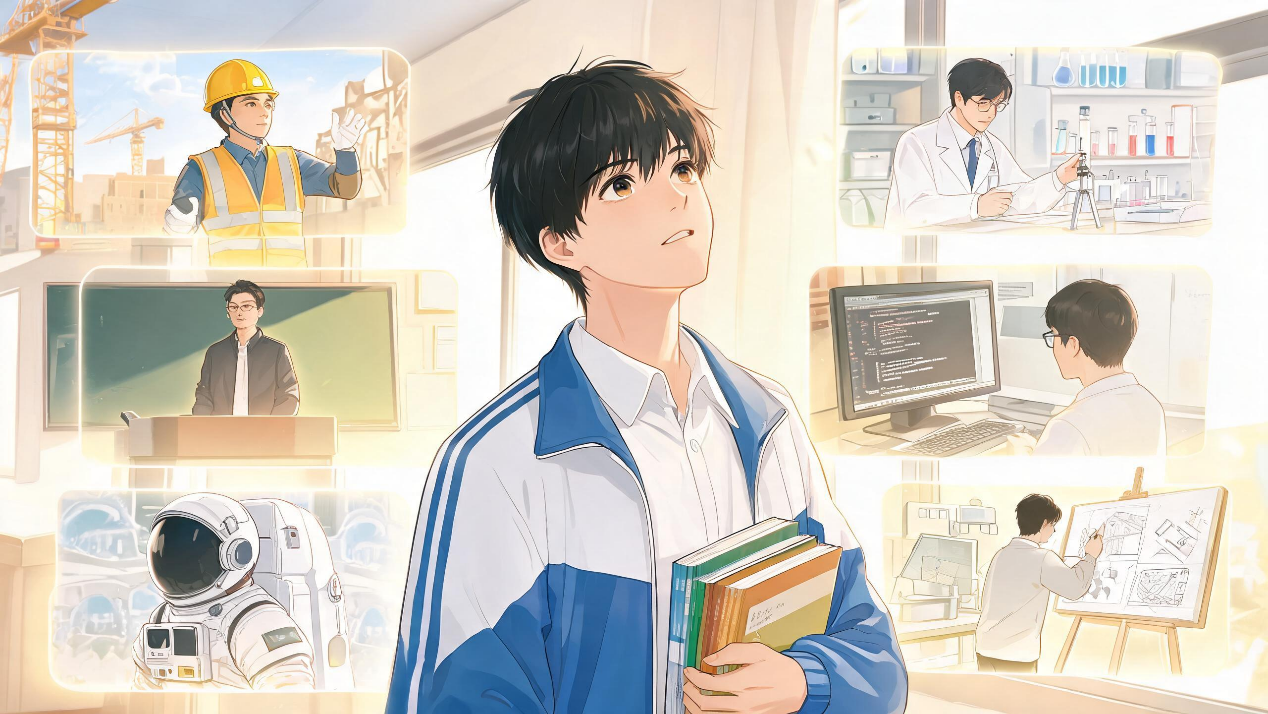
By the time counselor Shan of Fengxue Weilai took the case, time was already tight. Shan himself had once mis-filled his own preferences and slipped out of the batch he was aiming for; he knew all too well what one misstep costs a child from an ordinary family. He laid out the reality for them bluntly: competition in Shandong's gaokao is fierce, the bar for quality public engineering programs in the province is extremely high, and fields like computer science — "hot" majors in the public imagination — simply don't match Xiaocheng's score and rank.
"If you want to hold on to a public bachelor's degree and still study engineering, you have to look outside the province. I'd suggest looking at universities in Xinjiang." There was a brief silence on the other end of the phone. Xinjiang had never once come up in the family's discussions. It was too far away.
Shan broke it down for them slowly: public undergraduate universities in Xinjiang have more forgiving admission scores; some are authorized to recommend outstanding graduates straight into master's programs without the national entrance exam; local job-market competition is far less intense than in the eastern provinces; and the industry opportunities that come with national strategic priorities there can open up a differentiated path. "Rather than squeezing into a bottom-tier college in Shandong, go to a public university outside the province and ride its momentum. Let a young man go out and test himself for a few years — he'll come back with broader horizons and gains he wouldn't get at home."
After discussing it, Xiaocheng and his family took the advice. In the final list, in-province universities went into the reach tier, while public undergraduate universities in Xinjiang firmly occupied the "match" and "safety" tiers. The day they finished submitting, Xiaocheng — who had always said "I'll take each step as it comes" — suddenly said, quite seriously, "I want to go to graduate school." A boy who had never seriously planned his future had, for the first time, said out loud where he wanted to go.
Perhaps the point of this guidance is simply to help families see the options they didn't know existed.
Why does the SY Charity Foundation do this?
At a turning point in two young lives, one piece of pro bono guidance opened up new possibilities.
"We do this program for reasons at two levels," says Wu Na, Chairperson of the SY Charity Foundation. "At the practical level, the application-consulting market is marked by severe information asymmetry, and professional guidance routinely runs to thousands — sometimes tens of thousands — of yuan. Many frontline construction families can't afford it, and lack the channels to even find it. At a deeper level, this is of a piece with our values of 'sharing and growth.' At the most consequential decision point in a child's life, giving them professional support may change a person's trajectory more than any donation of material goods ever could."
Counselor Qi, who delivered the service on behalf of Fengxue Weilai, was struck by something throughout: "These families never once said, 'Help us get into a prestigious university.' The question they asked most was: 'Given our child's situation, what's the most reliable way forward?'"
That plain, unadorned hope is exactly where charity ought to reach: helping ordinary people dodge the pitfalls of limited information, and opening the door to a wider view. It helped Xiaoxin's family become certain that "the road beneath our feet is the right one," and it helped Xiaocheng's family discover that "there is, in fact, another road."
Both admission results are now in, and both exceeded expectations — each boy got into the school he had listed as a reach. Xiaoxin was admitted to Civil Engineering at Shanghai Normal University; Xiaocheng was admitted to Resource Exploration Engineering at Shandong Institute of Petroleum and Chemical Technology. "Wherever he was admitted, we're content," says Xiaoxin's mother. "Thank you. Everything turned out for the best." Xiaocheng's mother says: "I hope there's more charity work like this. There really are so many other families like ours."
Every brick and tile of a city holds the sweat of those who built it; every step of a young person's journey is tied to a family's hopes. Both boys got into schools they had hardly dared to imagine, and amid their joy, both families felt something uncannily similar. Perhaps this is what "the best arrangement" really looks like: it is never luck falling out of the sky. It is what happens when you face every crossroads seriously — without cutting corners, without running away — and do every bit of preparation you can. Life then hands back a kind of relative ease. That ease is knowing you did your utmost, so you have a clear conscience whatever the outcome; it is the feeling that once you have made your choice and let it go, life has met your seriousness with seriousness of its own.
Xiaoxin held his ground amid the chorus of doom, backed by his passion and his family's accumulated experience. Xiaocheng broke through the boundaries of what he knew and saw an option that hadn't existed for him before. The two paths are entirely different, but their core is the same: both chose to face the choice rather than be pushed along by it. What life gave them in the end was not a miracle — it was the solid certainty behind those four words: "better than expected."
SY Holdings' original intention in its charity work has always been to lift up ordinary families, giving them the confidence and support to face hard problems head-on. Going forward, the SY Charity Foundation will continue its public-interest work on gaokao admissions, and continue to focus on the families of infrastructure workers — so that professional admissions guidance reaches more grassroots families, so that these small lights keep gathering, and keep lighting the way for young people chasing their dreams.