

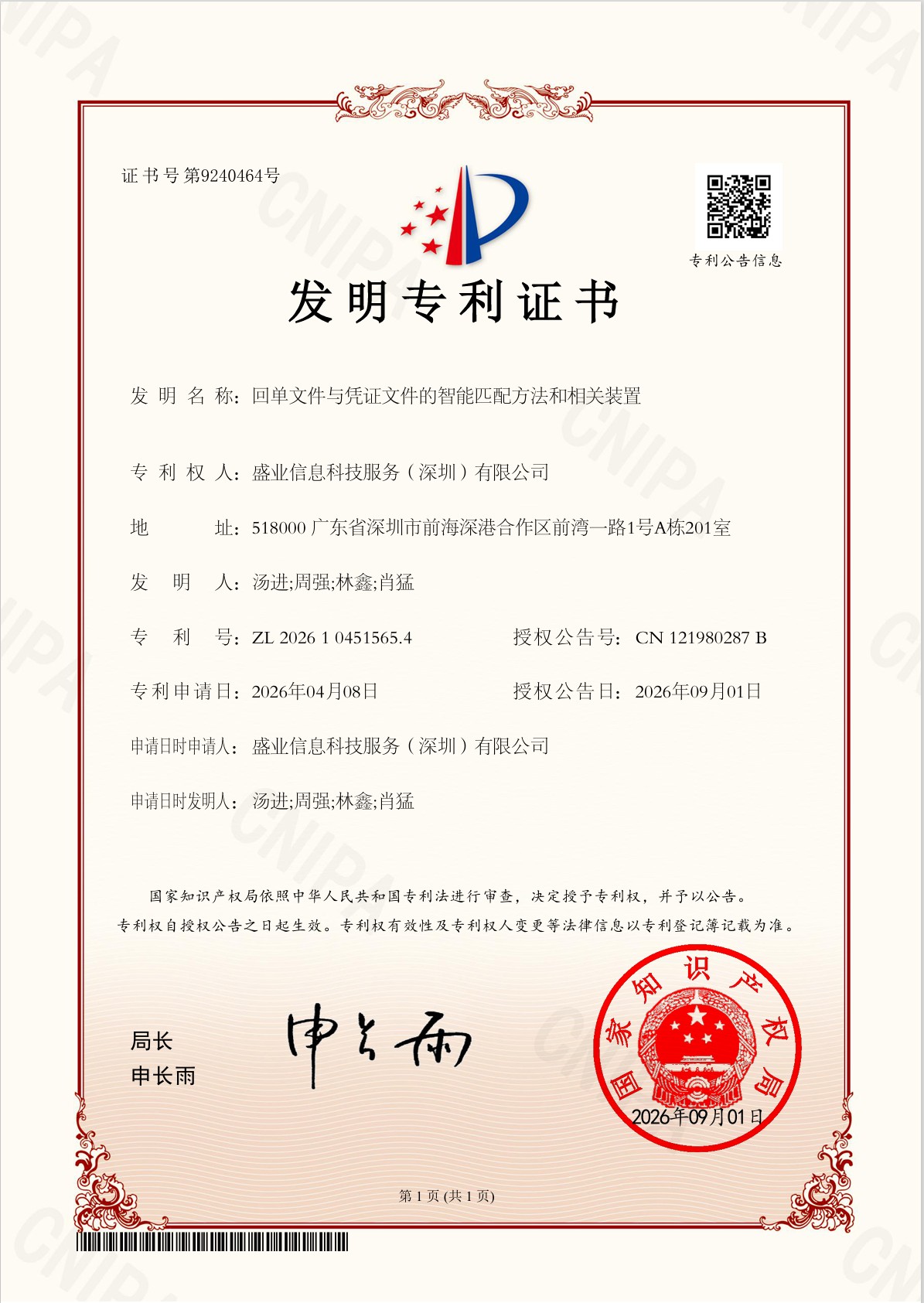
Recently, SY Information Technology Service (Shenzhen) Co., Ltd. ("SY Technology"), a wholly-owned subsidiary of SY Holdings Group Limited ("SY Holdings", stock code: 6069.HK), a leading supply chain fintech platform, has been granted an invention patent by the China National Intellectual Property Administration (CNIPA) for its independently developed "Method and Related Apparatus for Intelligent Matching of Bank Receipt Documents and Accounting Voucher Documents".
Receipt-and-voucher matching and reconciliation is a critical step in corporate financial accounting and audit traceability, directly determining the compliance and accuracy of financial data. Under traditional operating models, this work relies heavily on manual, transaction-by-transaction reconciliation, which is widely plagued by low efficiency, high error rates and difficulties in traceability. On the one hand, bank receipt formats vary from bank to bank, with significant layout differences, making manual collation and comparison time-consuming and labor-intensive, and unable to accommodate enterprises' high-frequency document processing needs. On the other hand, transaction descriptions on bank receipts differ considerably from the accounting line items used in vouchers, so purely literal matching is highly prone to mismatches and omissions. At the same time, manual reconciliation lacks standardized archiving records, leaving materials scattered and disordered and creating numerous obstacles to internal and external audit traceability and financial risk self-inspection. With the implementation of policies such as the "Caikuai [2025] No. 9" circular, full-process paperless finance and standardized electronic accounting archives have become hard compliance requirements, and the traditional manual reconciliation model can no longer meet enterprises' needs for compliant operations and refined management control.
To address these issues, this patent first establishes a hierarchical parsing architecture spanning "visual modality — textual modality — semantic modality" at the document parsing layer, breaking through the capability limits of conventional single-pass OCR recognition. The visual modality performs dynamic region segmentation of bank receipts based on layout structure, extracting raw image information within each segment. The textual modality enables precise field extraction and standardized normalization. The semantic modality further interprets the actual business meaning of unstructured text such as transaction descriptions and remarks. Through this three-tier progressive parsing, receipt and voucher data — originally heterogeneous in format and non-standardized — are uniformly converted into structured data suitable for matching. This upgrades the capability from simple "field-to-field correspondence" to business-level "relationship determination", resolving at source the core problem of disordered document parsing.
At the core matching stage, the patent adopts a dual-engine model of "rule-based matching + vector matching", balancing precision with scenario adaptability. The rule-based matching engine performs exact verification against strong identifying fields such as transaction serial number, amount, date, and payer/payee account numbers; it is suited to standardized, routine documents and safeguards baseline matching accuracy. The vector matching engine computes semantic similarity across business descriptions, transaction counterparties and fund usage, overcoming the constraints of literal wording differences and handling complex scenarios such as cluttered layouts, inconsistent phrasing, and consolidated or split transactions. The two engines work in tandem to output matching results, achieving a breakthrough in understanding the core logic of the business and covering the full range of corporate financial reconciliation scenarios.
Compared with the traditional manual model, this patented technology substantially reduces the proportion of manual intervention and significantly improves both the efficiency and accuracy of document matching in complex scenarios. At the same time, the system automatically consolidates data across the entire matching chain to generate standardized, traceable electronic archiving records that fully document the parsing logic and matching path. This provides reliable data support for financial accounting, risk control and audit inspection, while fully satisfying the compliance management requirements for electronic accounting archives. It drives the upgrade of financial reconciliation from "manual operation with ex-post verification" to a digital model featuring "automated execution, full-process traceability, and auditability and traceability throughout".
From the perspective of SY Holdings' technology roadmap, this patent is not an isolated efficiency tool, but a concrete application of its differentiated "transaction-focused, entity-light" risk control model in the field of financial compliance. Operating a business model of "industrial data-driven + AI-powered intelligent risk control + platform-based matching", SY Holdings' platform has served a cumulative total of over 55,000 SMEs, with intelligently matched business volume exceeding RMB 380 billion. The financial processing demands arising from massive transaction scenarios are both the starting point of its technology R&D and the proving ground for its deployment. At the same time, this patented technology not only strengthens the compliance foundation for the platform's own high-volume transactions, but also builds up a core technology module for SY Holdings to deliver digital and intelligent financial services to its corporate clients.
Looking ahead, SY Holdings will continue to focus on real pain points in supply chain scenarios, advance the deep integration of frontier technologies with business processes, and support business compliance and efficient growth through continuous technology iteration.